
 By Paulo Ravecca • Halifax • 2026-03-04
Many journalists and scholars approach the far right as an abnormality. This not only mirrors the “populist” scapegoating so forcefully rejected by liberals and progressives but also rests on a series of inaccuracies.
This talk argues that self-righteousness is a barrier to understanding the rise of the far right and that this political moment constitutes a powerful opportunity for radical self-critique. I examine how key elements of liberalism, neoliberalism, political science’s conventional conceptions of democracy, and even intersectionality and identity politics have been appropriated and weaponized by far-right actors. The far right is not external to “our” institutions, theories, and subjectivities; it has already reshaped our world.
I argue that the rise of the far right constitutes a powerful opportunity to exercise radical critique and self-critique.
My intellectual project is anchored in the power of self-reflection, understood as a theoretical and affective praxis. I have explored this theme in my work on the politics of political science in the Americas, narrative and autoethnography, attachments to innocence, and far-right politics. Building from this trajectory, this talk reflects on what it means to study the far right beyond self-righteousness.
Both journalistic commentary and much scholarly work tend to approach the far right as an abnormality—as the radical Other of democracy, liberalism, the liberal order, globalization, and modernity. This move not only mirrors the “populist” scapegoating so forcefully rejected by liberals and progressives, but also rests on a series of historical and intellectual inaccuracies.
Against this complacency, I argue that the rise of the far right constitutes a powerful opportunity to exercise radical critique and self-critique. I examine how key elements of liberalism, neoliberalism, political science’s conventional conceptions of democracy, and identity politics are appropriated, reworked, and weaponized by far-right actors. Moreover, these reactionary forces have already reshaped mainstream conversations around immigration, inequality, minority rights, and related issues. In this sense, the far right is not—nor has it ever been—external to “our” institutions and subjectivities.
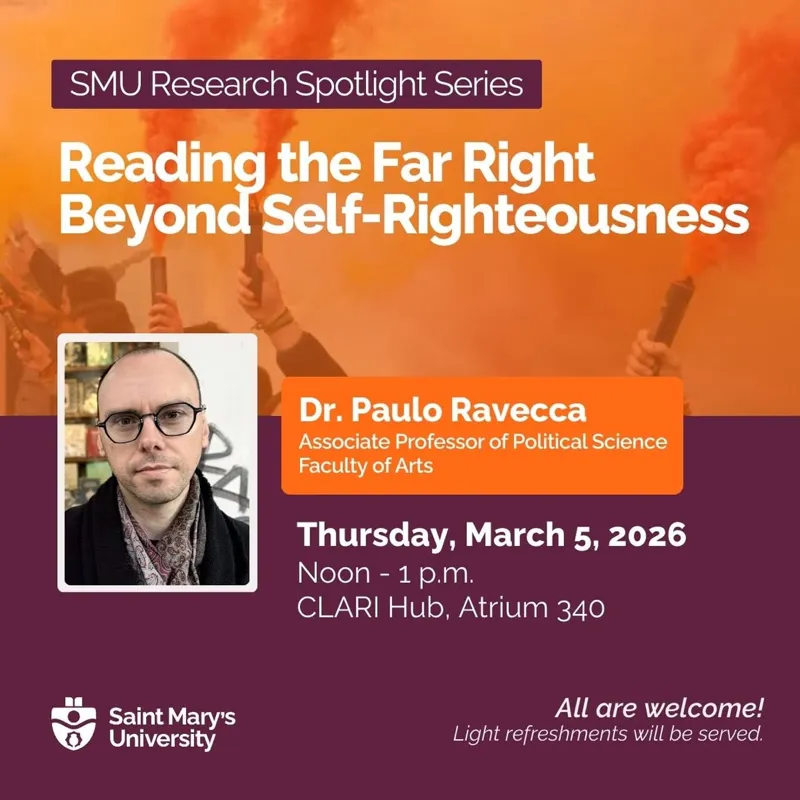
The talk will be on Thursay, March 5, noon - 1pm in person at the CLARI Hub, Atrium 340 on the St Mary's University campus in Halifax, and online via Teams here. Here's the Facebook event link.