
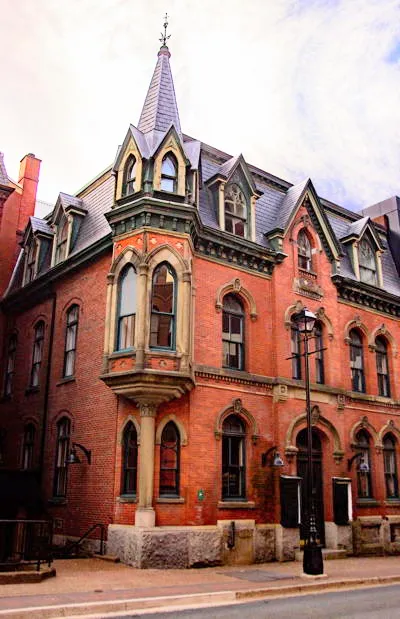
This cornerstone of 2SLGBTQIA culture in Halifax is threatened, and needlessly. Here's a love song about the space from writer, activist and historian Robin Metcalfe, and below, what you can do to help, and information about a movie about The Turret on Tuesday, March 10.
It was an improbable building for a gay dance club. The 1970s were all flashing light shows and high-tech speakers. The former Church of England Institute at 1588 Barrington was Victorian Gothic, with wainscoting, ceiling mouldings, parquet floors... and window frames pointing towards an Anglican heaven. And a turret projecting from the southeast corner, a handy spyhole for checking out street traffic. The top floor still boasted gingham cotton lamp shades on the ceiling lights, left over from Sanpaka, the hippy-dippy health-food restaurant that had been there in the early 1970s.
But it was available. Sanpaka had not lured enough customers up the three broad flights of stairs with their heavy wooden bannisters. Other counter-cultural types had tried to make a go of it as a music venue, with folk, jazz, and blues nights several evenings a week, but when the Gay Alliance for Equality decided to organise a dance night, the Youth Employment Society was ready to rent it out, even to a bunch of militant homosexuals.
David's club – Thee Klub, as it styled itself – was directly across the street, on the top floor of the Green Lantern Building. That made it handy for people hedging their bets about where the best party was. David's had been the chief gay social site in Halifax for several years by 1976, but it did not have a licence, and the clientele was overwhelmingly male, or at least, assigned male at birth. More men in dresses than cis-gendered women in any kind of attire; usually more “fag-hags” – straight women with close gay male friends – than lesbians. Gay men had habitual cruising grounds – Citadel Hill, the Commons, the “Triangle” formed by Dresden Row, Artillery Place and Queen. We were sometimes tolerated in certain corners of local bars, such as the Cameo, the Heidelberg, the Dresden Arms, or the notorious Piccadilly – so long as we didn't act too visibly gay. Showing much affection was frowned upon, and dancing together or kissing were out of the question. Coming and going from any of these places meant running a gauntlet of potential “fag-bashers.” Like other people on the margins, we felt safer in the very wee hours of the morning, when even fag-bashers had less stamina for staying up then did gay men looking for sex.
GAE was unusual for the time. Most “gay” organisations in North America were overwhelmingly male, and mostly white, college-educated, young men. Lesbians tended to cluster in the women's – or womyn's, or wimmin's, community – a loose, not always comfortable mixture of straight and women-loving feminists. The fifteen founding officers of the Gay Alliance, however, their names and occupations listed on the 1973 Memorandum of Association, included eight women and seven men. There were three cooks, a baker, an accounting clerk, a self-employed businessman, a teacher, a day-care worker, a laundry worker, a student, a housewife, an office manager, an assistant manager, and a “road supervisor” (whom I knew to be, in fact, a railway porter). One was Indigenous. Mostly working-class, or bottom-rung white-collar workers, taking the enormous risk in an era when no human rights code in the world protected us, of listing their names and addresses on a public document, in the bold and revolutionary hope of changing the world they lived in.
it was there that I realised a miracle had happened.
The demographic represented in GAE did not feel uniformly well served by the existing social options; the women in particular. So we decided to hold a dance. I remember chipping in $20 towards the beer fund. As a registered non-profit society, we were entitled to two special occasion liquor licences a month. There was no fridge on the premises in January 1976, but there were two skylights and one ladder leading up to the snow-clad roof, where we stored the beer to keep it cold. I took my turn at the door as people paid admission, and it was there that I realised a miracle had happened.
The turnout, that first night, was amazing. Where there had been a small, stubborn movement, a notion of freedom, there was suddenly a community. Lesbian women and gay men dancing and chatting and flirting in the same space – a space that we controlled. GAE saw its opportunity, and started organising more dances. The constraints of a semi-monthly licence were overcome when we took over the lease for the space and secured a private club licence from the Liquor Licence Board.
GAE represented a generally poor community. The Turret made it one of the most well-funded Queer organisations in North America, and came to provide employment to scores of 2SLBGTQIA+ people: African Nova Scotian DJs and Black lesbian bouncers; Acadian drag queen busboys; lesbian feminist singer songwriters. Gay men lobbied the DJ for the latest disco hits. Lesbians demanded more slow waltzes, and claimed a corner of the L-shaped space for themselves.
The space hosted regional conferences, and during the national gay and lesbian conference in summer 1978, an original musical, The Night They Raided Truxx, based on a police raid on the Montréal bar of that name. Monthly GAE meetings in the Turret became a kind of general assembly for the Halifax community, empowered and entitled by their ownership of what had become the principal Queer social space, not only in the city, but in the four-province region.
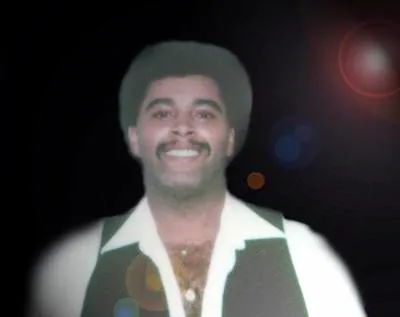
It was a place of empowerment, in more ways than one. Chris Shepherd, the six-foot-plus DJ, had grown up in the historically Black neighbourhood of “The Avenue” at the end of Crichton Avenue in Dartmouth. He was as flaming a fag as he cared to be, and was taking shit from nobody. From his aerie in the eponymous turret, he would see queer-bashers harassing patrons on the street below, and would interrupt the music to make the fact known. The Halifax police were known to react with indifference to anti-gay violence, and would take their time showing up to protect us, if they bothered at all. At Chris's call, however, a crowd of fifty fags and dykes would descend to the street and confront any bashers crazy enough to give us trouble.
The Armed Forces's Special Investigations Unit (SIU) set up a looking post across the street, to photograph service members coming and going. It was the era of the Purge, and Queer and Trans members of the Forces routinely had their careers cut short. The rest of us would turn and wave to the SIU, to let them know we knew they were there. My friend Anne Fulton and I wrote a ditty that we performed in the Turret, to the tune of “Santa Claus is Coming to Town,” called “The SIU Is Watching You Now.” “They know who you've been sleeping with, they know if you're of age, they know if you've been gay or straight, so be straight, for goodness sake!”
While northwestern Europe – the Netherlands, Scandinavia – had a history, since shortly after World War II, of Queer non-profit community-owned spaces, the model was little known in North America, particularly when the community was gender-mixed, racially diverse and largely working-class. And where the social space was not a small cubby hole maintained by volunteers, but a large, professionally run disco with the most up-to-date house music fresh from New York and Chicago.
The Turret lasted at that location for six years, from January 1976 until the summer of 1982, when it moved and changed its name to Rumours, first on Granville Street, then, more substantially, on Gottingen Street in the former Vogue cinema. The tradition of a community-run space – democratically answerable to that community, responsible for providing for its varied social needs and using the proceeds to fund a range of social, cultural and political services – lasted for two decades in Halifax. The second Rumours was a spectacular space of multiple levels, and reputed at one point around 1990 to be the best dance club in Canada. The community's deepest affections, however, have always been for the Turret, with its awkward, anachronistic charm, where hundreds would line the long curling staircase to get into the club that belonged to us.
2SLGBTQIA+ people, even today, rarely grow up in Queer-identified families. We have to seek out our communities as adults. Our special places as Queer people are not the places we grew up in, but the places where we eventually found our people; the places we made for ourselves. Of those places, there has been none more beloved, more special, more empowering, more historically charged with the lives of Queer and Trans people, anywhere in Canada, than the Turret.
The Turret building holds many special histories for many communities.
The Turret building holds many special histories for many communities. Afghan immigrants, the Nasr family, ran the city's main health-food story on the ground floor. The second housed the Youth Clinic, run by Dr Fredrickson, serving marginalised communities, including people with AIDS and HIV. Many artists had studios. The Khyber, an artist-run centre, began its life and operated for twenty years there; it has since evolved into a primary exhibition space for Queer and Trans artists. The Khyber bar became a key venue in the Halifax independent music scene, immortalised in songs by Joel Plaskett. Wormwoods's Dog & Monkey Cinema succeeded the Turret in the third-floor space. Both the Khyber, and Leave Out Violence (LOVE), serving youth at risk from violence, including in African Nova Scotian and Indigenous communities, have both committed to being anchor tenants in the Turret Arts Space if the City allows the project to come to fruition.
For no community is the building's protection more important than for the 2SLGBTQIA+ community. It forever has our love. It deserves the love and care of our municipal government. For HRM to allow the building to slip out of the hands of the communities it has served, and to be rendered a mere surplus asset, would be a crime against the Queer community, recalling the crime committed against the Black community when Halifax bulldozed its place of history and self-empowerment, Africville, six decades ago. HRM had to rebuild the Africville church – it would have been a lot cheaper not to tear it down in the first place. The wounds are still fresh in the survivors of that community.
The Turret is not real estate. It is flesh of our flesh. It is the grandmother of all the Queer spaces, and the grandmother of the desire for more Queer spaces, in Halifax in the five decades since it opened. Its walls store the laughter and tears, the songs and the shouted slogans of generations of Queer and Trans people. The Queer and Trans communities of Halifax must not allow our special place of history to go the same way as Africville.
From: Turret Art Space Society
In November 2025, Halifax Regional Council voted to repurchase 1588 Barrington Street from Turret Arts Space Society, declare the property surplus, and initiate a disposal strategy for the property. The report by HRM Staff on which Council made its decision seriously misrepresents the competency and viability of the Turret Arts Space redevelopment plan. We want to reclaim this space as a Queer space, which it has always been, and open it up all of the 2SLGBTQIA+ community.
Take Back the Turret! Here's what you can do to help:
- Donate to the Turret Art Space Society using this link
- Write a letter of support to your Council members. Here's a template to send the letter very easily.
- Contact your city council members and get them to vote against disposing of this property!
- Attend the film, the call-in history sessions with people who were there, and the parties: details below.
 Film
Film
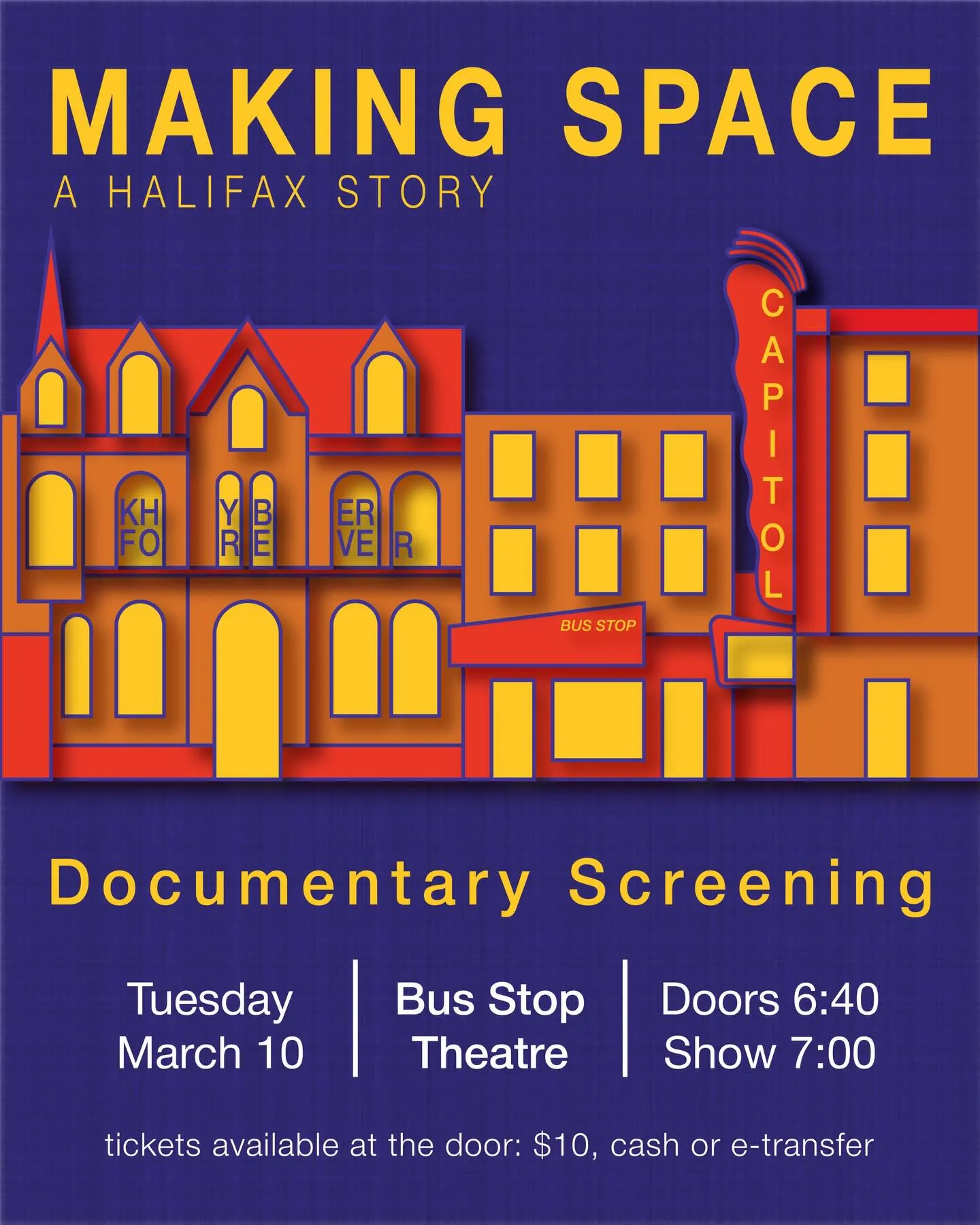
Tuesday, March 10: Gareth Wasylynko is showing Making Space: A Halifax Story detailing the fight for iconic arts spaces in Halifax. "Asbestos, bulldozers and property evaluations threaten space for the arts in a growing city. Delve into the stories of Halifax’s iconic art spaces as they fight for their future." Feature length documentary. Doors open at 6:40, film at 7pm, at the Bus Stop Theatre, 2023 Gottigen St., Halifax, NS
Call-In
Tuesday, March 17: The Turret will be open to the public at noon for a call-in to Council and historical seminars from people who were there, in conjunction with NSCAD Strike students. Noon - 1:30pm at the Turret, 1588 Barrington St.
Show up in support of the Turret!
Saturday, March 21 8am-1pm: Community Table at the Halifax Brewery Farmer’s Market. There will be t-shirts and buttons for sale. At: 312-1496 Lower Water St.
Saturday, March 21 10am-2pm: Turret Building Open House, free building tours, open to the public. At: The Turret, 1588 Barrington St.
Sunday, March 22 2pm-5:45pm: Turret Building Open House, free building tours, open to the public. At: The Turret, 1588 Barrington St.
Sunday, March 22 6pm-9pm: Queer Variety show featuring Elle Noir, Asiah Sparks, Sassafrass Smalls, Mo Kenney, Sophie Noel, Robin Metcalfe, Cam Tynes and more, followed by karaoke. Raffle prizes, t-shirts, buttons for sale. Entry by donation, suggested donation of $25. Event is open to all ages. At: Stardust Bar + Kitchen, 1688 Barrington St.
Friday, March 27 9pm-3:30am: Glitter Ball, a One Night Gay Disco, featuring Nectar Collective DJs aniiiiiiiiiiiiiiiiita, pollysporyn, DJ Decision, DJ Dumb Little Bitch, and drag performances by Moist Towlette and Mike Hunt. Raffle prizes, t-shirts, buttons for sale. Tickets for sale at the door, $25. At: Rumours Lounge and Cabaret,1668 Lower Water St.