

Indie screenings are on the rise all over Halifax, and—by no coincidence at all—June and July saw some of the queerest across the city.
I was lucky enough to attend Propeller Arcade’s screening of 1983’s Siege, an event cohosted by Strange Brew Film Society that featured a Q&A with co-producer and director Paul Donovan.
The film—shot entirely in Halifax—follows the sole survivor of a massacre at a Halifax gay bar who takes refuge in a nearby apartment after narrowly escaping. The apartment’s occupants decide to shelter him and fight off the fascist anti-gay hate group responsible for the killings by whatever means at their disposal.
Siege takes place during the real-life police strike of 1981, the film’s background inspiration, and contains real footage of the strike that can only be seen in the film.
Donovan, also who wrote Siege (released as Self Defense in Canada, a casualty of importunate “douche-bag distributors” according to Donovan), agreed to sit down with me at Ramblers Coffee to talk about the film’s production, legacy, and the lingering controversy around it.
In November 1981 production began on the film whose goal was to be “more gay than this cafe!” even with the backlash from the local queer community at the time, which included the GAE (Gay Alliance for Equality) denying the producers’ request to shoot inside the interior of the Turret.
DR: Given the initial backlash from the GAE, do you feel there's anything you would approach differently if given a do-over? I know you filmed guerilla-style outside of the Turret.
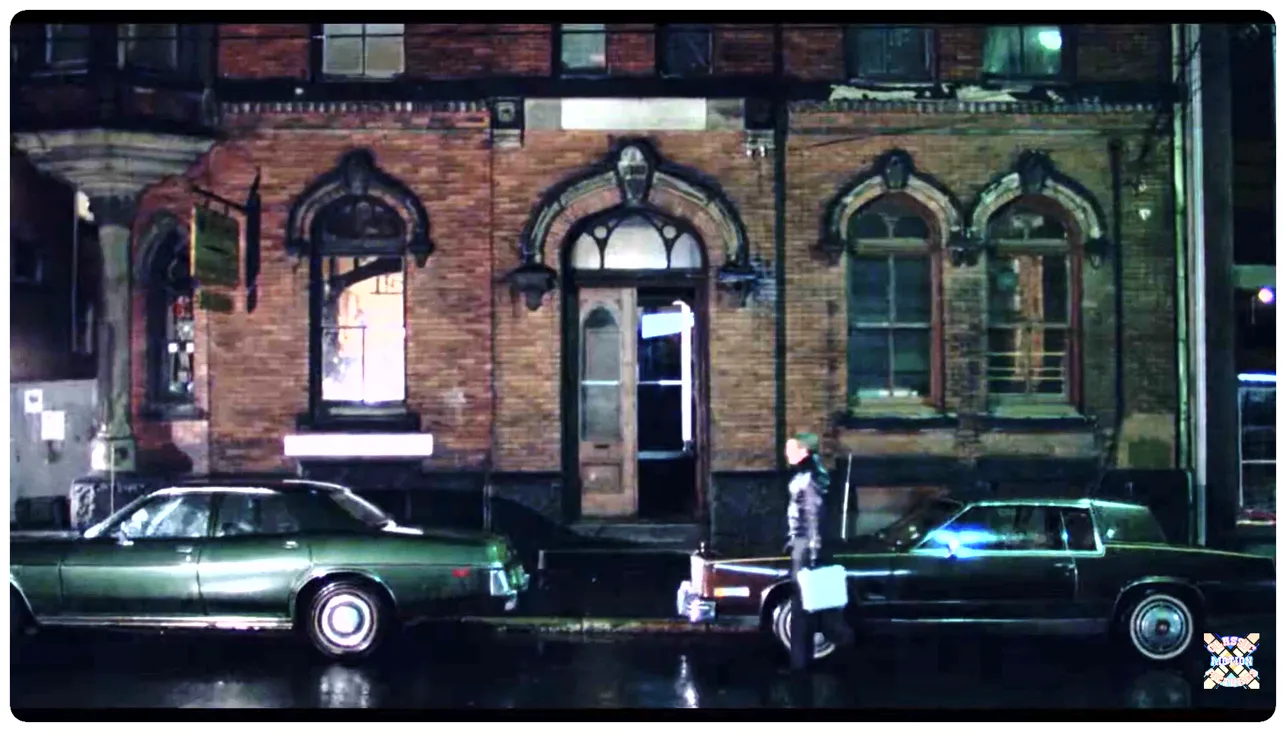 PD: No. I mean, we filmed guerilla style more than outside the Turret. There's a scene where the rocket flies onto the top of what's the Masonic Lodge. We went several buildings over, across the roofs, and shot on their roof. We didn't ask their permission. We wouldn't have gotten it. And you just have to do that. You just have to. You can't please people. We're making a film that we hope we feel good about. And that's all you can do.
A gigantic problem with the Canadian film industry today, is people are almost disallowed from doing that. When we were making it then, we wanted it to play in Paris and make money. Whereas now, when you make a feature film in Canada, nobody ever watches them. It's kind of a sad thing. All the money comes from the various agencies. And when you're making a film, you think, I need to choose a story that's going to get me the money. And that's not the audience anymore. That's the various poor crowds who have their checklists, and also their fears. Their fears of what can't be done. So it's kind of a terrible situation. But at the same time, when I hear about something like Obsession, I see these people who broke the rules, and they made the film that they wanted to make, and it reached an audience. So I think, okay, it can be done.
DR: Do you believe some of the negative criticisms that you received from the gay community are a matter of misunderstanding the genre and the work that you were creating exactly?
PD: Oh, look, that was only local. You know, we didn't get any problems with the gay community outside of Halifax. You know, like it was invited to gay film festivals. It went over extremely well. Also, if you read on Letterbox, I see a lot, you know, there's a certain type of writer I see and I go, “That is a gay man. And he is outraged, because he said, you know, watching those people get cold blooded executed, that was the worst experience of his life. But it made the denouement in the end, and that was the best experience of his life.” And I said, well, that's our job.
And there’s no escaping it. There’s always a critic. You have to be a bit of an adult about it and say, you know, look, sorry. Don’t watch it.
The only film festivals this film ever went to were gay film festivals. We never got invited to any mainstream ones. I think they were a little bit like, “That, well, it's just a little bit too…” but the gay festivals didn’t feel that way. It didn’t put them off.
DR: Did the film’s queer themes feel relevant coming back to Halifax?
PD: Well, no. Things were not as well developed. You know? The point is, in London, I would be sometimes working on gay films, but that was treated as just a normal thing. And here it was more, you know, a hush-hush topic. Like, okay, grow up.
DR: Do you think that audiences are more receptive now to what you put on the screen versus then?
PD: Well, that's what I'm learning. I'm learning this exact audience was…I didn't have that experience initially. I can't explain what's changed, but I'm sitting in a Halifax audience, and they're lapping up the genre content, and being enthusiastic and supportive of the underlying themes at the same time. And I go, that's what we were trying to do. And to wait this long for this reaction. Although, we did get that back in other places.
DR: And they understood better the ideas you were working with?
PD: Well, sort of, but I mean, in somewhere like Paris, people fully understood that at the time. I mean, Paris is a very sophisticated place. Even more sophisticated than Toronto. And it played in places like South America, and Asia and did quite well. But I think people thought “a gay club, that's just weird.” But it was still there. They still had to suffer through that element of it. But they're only watching it for the genre, right? And they probably were a little bit bothered that, you know, Daniel, who's their gay character, in the end does the final chop, so to speak. Why didn't the handsome hero get that?
Yeah, putting him in a closet is a bit of a cheap shot. At the time, I do remember thinking: can we really do this?
DR: I think that's what made the film so strong. I had a lot of the same reservations as the film’s critics while watching the movie unfold, primarily about the central queer character being demeaned. I found myself thinking, “Is the last remaining gay character just going to stay in the literal closet during all of the action?” but I was pleasantly surprised by the set up and pay off by the end along with the filmic gender roles and overall queer-positive anti-cop messaging.
PD: Yeah, putting him in a closet is a bit of a cheap shot. At the time, I do remember thinking: can we really do this? But we did. And the actor Terry-David Després certainly discussed that. He was not straight.
DR: And do you think Terry-David Després was happy with the performance? The turn at the end of the film, his character Daniel’s arc?
PD: Oh, no, he was super. He was a real true believer.
DR: And you designed the arc that way? You thought, “I want him to have an adventurous, heroic escape at the beginning, become more docile, literally put himself in the closet out of fear, then give him the final climactic kill at the end?”
PD: Yeah. I mean, the point is, the traditional thing (in action genre films) is you have the hero and the heroine. And she's a little bit floozie, and he comes through and he's the guy and everyone cheers for him. And that's a little too boring. So the idea that Terry would be the one to do it, that Daniel be the one who does the thing, the whole film is set up for that. This was not a last-minute decision.
And then we have this character, Chester, who is, I think he did the best performance, actually. He just sort of owned it the most, played by Daryl Heaney. You know, he also doesn't survive. So if you see him as the hero, we're breaking that rule. You've got to play with the genre to make it work. If you do it just straight up, it’s not that interesting. But it was very satisfying. It’s satisfying to me as a filmmaker, and I know, unless you hate gays, it's satisfying to the audience when Daniel gets the final chop.
DR: How do you feel about the current popularity of indie screenings?
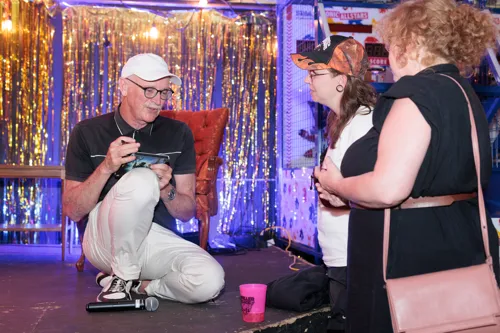 PD: I'm overjoyed. And surprised. Because, you know going to the cinema kind of has died… And the idea that you can walk to a cinema, and it's a communal experience, is one of life's greatest joys. And you don't get that in the Bayers Lake cinema. The movie doesn't invite us, the drive doesn't invite us. So, to me, nothing is dearer to my heart, and I'm really happy that that's appearing in Halifax. And I really salute Ian Matheson for being the impresario.
DR: There are a few different moments where characters fumble and then get to have moments of success and they alternate in a very realistic way. For example, the shot when Horatio is about to shoot through the mirror without realizing his gun isn’t loaded, or we see the character of Barbara fight off Cave, the fascist ringleader, using the knife when she's being attacked, but we also see many times that she is genuinely afraid without necessarily being the damsel. How intentional was that?
PD: It's all in the writing. And I'm a real believer that it's in the process; it's kind of straightforward. You can't have a good movie without a good script, even if you have good actors, good direction, and good everything. When you write the script, if you understand the genre, there's no planning; it has to write itself.
DR: I must ask: watching the film, I and a few other people in the audience, I think, had this feeling we were picking up on some romantic tension between three characters: Chester, Horatio, and Barbara. I know that Barbara and Horatio represent the stand-in couple, but even the dynamic within the apartment building and the way they all essentially live together and implicitly depend on one another, how that was arranged felt almost queer platonic.
PD: That really came from the actors, and I would say that was their highest achievement, that they were able to play that in a light-handed way, you know, be subtle and work with it. Because as a filmmaker, you don't really know who you are going to get, whether you can present that kind of a challenge to the actor or not. And then they rolled with it. So looking at that from the outside, I say, "Well done!"
what I've learned in my age is that, you know, you gotta do what you gotta do rather than do what other people are telling you to do
DR: What do you consider to be this film's legacy?
PD: Look, I would only say that what I've learned in my age is that, you know, you gotta do what you gotta do rather than do what other people are telling you to do. And eventually somebody will recognize you.
DR: The irony of that statement is I think that's how most queer people feel about existing in general.
PD: Yeah, that makes sense. I mean, because the whole point of the queer element of the film is that you have a marginalized group. And the marginalized group, it's oppressed, right? And it has to be believable. And it is for you. It is believable that there's a bunch of fascist, right wing people who hate gays, who might take advantage of an opportunity like that. I mean, pushing and pushing. But it's not complete fantasy. That could happen in real life. So that's the key. So, you know, seeing it from the point of view of a marginalized group, you're still marginalized. Doesn't change. That has changed and it hasn't changed.
Links
- The Halifax Rainbow Encyclopedia article about the film is here.
- It is available on Youtube, here. Warning: this is a 1983 action film. It features extreme violence and extreme homophobia.
- Paul Donovan's IMDB profile is here.
Drue Robyn is a multidisciplinary writer and editor who has lived in Halifax/ Kjipuktuk for over 12 years.