
Dear Wayves readers:
Just last week, during one of our typically Halifax city other-worldly mornings, I discovered a mysterious capsule which had apparently fallen through a time vortex! Inside was the transcript of an interview done [Editor: to be done?] in July 2056 between a future Wayves Magazine writer and a famous local author, discussing the history of the speculative fiction renaissance in Halifax!
I have summarized the interview here, and in order to preserve destiny, free will, and indeed the very fabric of space and time, I've redacted their names.
Interview date: July 1, 2056
WR (Wavyes Reporter): Hi *Redacted*! I'm so grateful you could join me. I know Wayves readers and viewers are excited to learn about the international success of a queer speculative fiction writer like yourself.
AN (Author's Name *Redacted*): Thank you! I'm delighted to share my experiences and encourage aspiring 2SLGBTQIA+ writers and creators in the region. You are all so lucky to be living in a place that became a centre for creative renaissance thirty years ago.
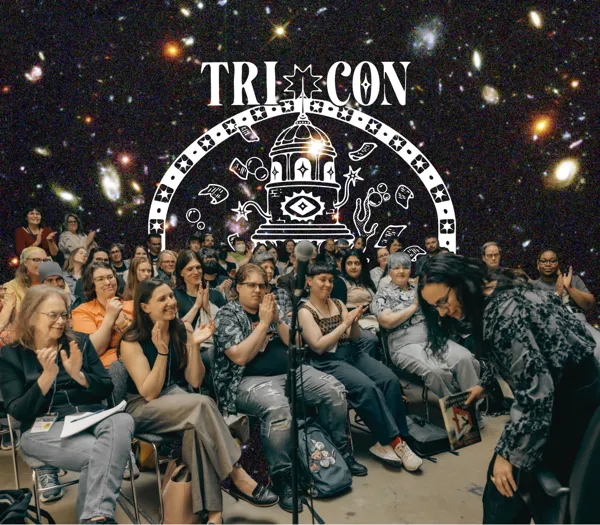 WR: You got your own start here in at the very first TriCon in 2026 didn't you?
AN: I was just a kid then -- I'm the little one, way in the back of this photo, but I was already dreaming and writing and a few years later I went to TriCon, my first ever writers conference, and pitched my first novel!
WR: Back in the late 2020's, did you have any idea that this area would grow into such a fomenting scene of creativity and culture?
AN: No I had no idea, but some people did. I remember the founder of TriCon, Charlotte Ashley saying Kjipuktuk (for awhile also known as Halifax) could become "Nashville of the North!"
WR: What's Nashville?
AN: I don't know, I believe it was a cultural landmark in the region south of here. You know, the place formerly known as "USA" (prior to its peaceful dissolution into the Turtle Island Confederacy).
What's Nashville?
WR: Okay. Wow. But, what made this area grow into such a fertile bed for writing and creative arts?
AN: Movements like TriCon were essential. When Charlotte Ashley, a writer who had been active in the Speculative Fiction scene in Tkaronto, moved to Kjipuktuk she found the place was already rich in talented writers, but a lack of infrastructure to encourage them to network with each other or with editors and publishers. At that time, the spec fic conference circuit was at an all time low. Charlotte remembers there used to be one in every major city in Kanata, but that had dwindled to only KanCon in Adawe and When Worlds Collide in Mohkinstsis. She decided to launch the first conference of its kind in Kjipuktuk, a conference that focused on creators and participants in the industry rather than on fandom and celebrities, as one may have found at a "convention" like HalCon or the like.
WR: How did it work?
AN: Like magic, (or at least extremely advanced science)! Charlotte and the Directors of TriCon stated that their mission was to support and grow the local creative industry by providing workshops, panels, lectures, and readings designed to nurture and inspire their writing and publishing careers. And judging from the results, they were extremely effective.
WR: In what ways?
AN: Well many people discovered that they weren't alone, that there were already many writers of fantasy, science fiction, horror, and speculative genres all around them. After the conference they worked, building community, forming writing groups, sharing ideas, giving each other feedback and encouragement.
WR: What was it like for 2SLGBTQIA+ writers back then?
AN: Well historically speculative fiction was a genre, that by its very definition allowed writers and readers to remember the revolutionary phrase "another world is possible" and this freedom provided space for imagining possibilities. But even in 2026, offering space for Black, Indigenous or queer writers required intentionality. It was barely a decade since reactionary movements like Sad Puppies and Gamergate had organized efforts to push almost anyone who wasn't white, male, and straight back out of the industry. Conference organizers could not be "neutral" without implicitly favouring people who already had power and privilege. The Board of TriCon noticed this, and planned panels, policies, and guest selection attempting to rebalance representation. Which made it possible for some queer conference attendees to feel seen and safe and encouraged to raise their voices. Charlotte recognized after the first conference that much more work needed to be done to improve representation of BIPOC writers, this became a priority in future conferences.
was TriCon solely responsible for turning Kjipuktuk into the iconic scene for speculative fiction and arts that it is now?
WR: So was TriCon solely responsible for turning Kjipuktuk into the iconic scene for speculative fiction and arts that it is now?
AN: Of course not! It was one of many factors, including the economic pressures that drove creative people out of more expensive cities, the unique features of the region that let people lead a combined rural/urban life, the natural weirdness of the weather... And don't forget the role of the writers and editors of Wayves in fostering the natural creative talents of the queer community. Do you remember when Wayves was just an online magazine?
WR: What does "online" mean?
AN: Wow, you really are young!
WR: On that note, *Redacted,* we'll have to wrap up our interview so that it can be capsuled and prepared for bicycle-relay distribution to all our viewers and readers in the autonomous independent communities in Mi'kma'ki and beyond. And to all of you following us, in this timeline and others: Serenity!
AN: Serenity!
 Well, my dear present day (2026 CE) Wayves readers, I'm sure I know what you're thinking:
Is this real? Will the internet go offline? Will the United States really "peacefully dissolve?"
Can Halifax become a hotbed of horror, a scene for sci-fi or a fountain of fantasy???
All I can say is that despite this unsettling experience, I believe that we can make our own future.
Only last month I personally attended TriCon and interviewed Charlotte Ashley and I can confirm that this region is full of talented speculative writers; some have vast experience and knowledge and some are just starting out. Any one of them might be the very same celebrated author interviewed in the future time capsule. Any one of them might be you. There are writers groups forming; you can find one yourself. Just for example every Tuesday night is "Write Night" at the Trident Cafe in Kjipuktuk (Halifax). Check out Trident's events page here or Like on Facebook.
TriCon will return next year in the spring. Watch this space among others for news on that front. In the meantime remember... another world is possible.